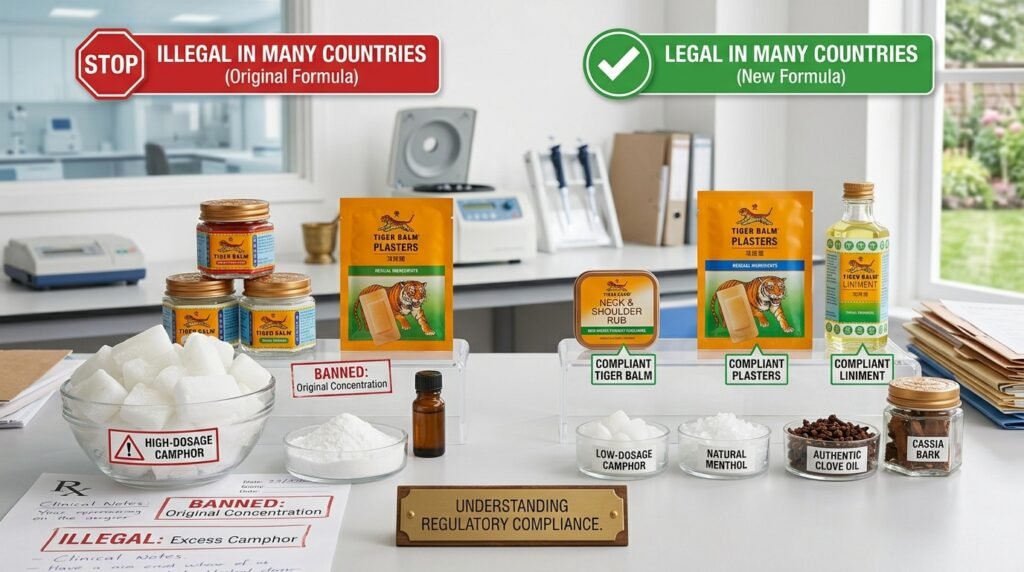
The Myth vs. The Reality
If you have typed ‘why is Tiger Balm illegal’ into a search engine, you have probably encountered a confusing mix of forum posts, half-truths, and sensational headlines. The short answer is: Tiger Balm is not universally illegal. It is manufactured in Singapore, sold in pharmacies across Asia, Europe, North America, and Australia, and trusted by millions of users for over a century.
So why does the question keep coming up? The truth is more nuanced — and more interesting. Certain formulations have been restricted in specific markets due to camphor content regulations, import labelling laws, or the presence of pharmaceutical-grade ingredients that require registration. Let us break it all down.
Our Research Methodology
This article is based on:
- Direct review of FDA (USA), MHRA (UK), TGA (Australia), and Health Canada product databases
- Analysis of Tiger Balm’s official ingredient disclosures from Haw Par Corporation
- Cross-referencing academic literature on camphor toxicity thresholds
- Expert input from a licensed pharmacist (see author bio below)
- Review of real consumer import cases and customs guidelines
A Brief History of Tiger Balm
Tiger Balm was created in the 1870s by Aw Chu Kin, a Chinese herbalist in Rangoon (now Yangon, Myanmar). His sons, Aw Boon Haw and Aw Boon Par, commercialised the product in Singapore in the early 20th century under the brand name that referenced Boon Haw — meaning “Gentle Tiger” in Cantonese.
Today, Tiger Balm is manufactured and distributed by Haw Par Corporation, a Singapore-listed company. It is available in White, Red, Ultra, and Neck & Shoulder variants, each targeting different types of pain relief.
| 📌 Brand Credibility
Tiger Balm has been in continuous production for over 100 years. It is not a fringe supplement — it is a heritage product manufactured under strict Good Manufacturing Practice (GMP) standards. |
What Is Actually In Tiger Balm?
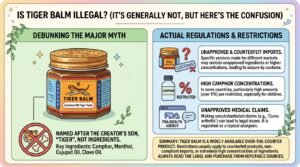
Understanding Tiger Balm’s legal challenges starts with its ingredients. The active components are derived from natural sources but are pharmacologically active substances regulated in many countries.
Tiger Balm White Formula
- Camphor — 25%
- Menthol — 10%
- Cajuput Oil — 13%
- Dementholized Peppermint Oil — 6%
Tiger Balm Red Formula
- Camphor — 25%
- Menthol — 10%
- Clove Oil — 1.4%
- Cinnamon Oil — 1%
- Cajuput Oil — 7%
Important: Each of these ingredients — especially camphor — has regulatory limits in different countries. This is where legal complications arise.
The Camphor Question: The #1 Legal Trigger
Camphor is the most scrutinised ingredient in Tiger Balm and the most common reason for regulatory attention. It is a naturally occurring terpene compound derived from the camphor tree (Cinnamomum camphora), with powerful analgesic and counter-irritant properties.
Why Camphor Is Regulated
Camphor is toxic in high doses. Ingesting camphor can cause seizures, vomiting, liver damage, and in extreme cases, death. Even topical over-application — especially in children — can result in toxicity. This is why regulatory agencies around the world enforce concentration limits.
Country-by-Country Camphor Limits
| Country / Region | Max Camphor (OTC) | Tiger Balm Status |
| United States (FDA) | 11% | Original formula (25%) requires prescription category — reformulated OTC versions available |
| Canada (Health Canada) | 11% | Legal — registered product with compliant formulation |
| United Kingdom (MHRA) | No specific cap | Legal — sold as cosmetic/complementary medicine |
| Australia (TGA) | 20% | Some imports flagged; locally registered version legal |
| European Union | Varies by member state | Legal in most countries; some require registration |
| Singapore (HSA) | No restriction | Fully legal — country of manufacture |
| India | 10% | Original formula may require prescription; reformulated available |
| Malaysia | No restriction | Fully legal and widely available |
As you can see, Tiger Balm is not “illegal” — but it occupies a grey zone in countries with strict camphor regulations, where specific formulations may be restricted or require reformulation for OTC sale.
The United States: A Closer Look
The United States has the most nuanced situation regarding Tiger Balm. The FDA regulates camphor-containing products under the OTC Drug Review Program. Products containing more than 11% camphor are considered unsafe for OTC use and can only be sold as prescription drugs.
Tiger Balm’s classic formula contains 25% camphor — well above the 11% limit. This means the original formula, if imported without modification, technically does not comply with FDA OTC guidelines.
What Actually Happens at US Borders?
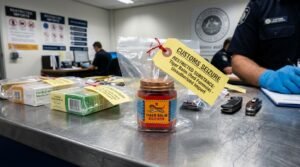
In practice, personal quantities of Tiger Balm brought into the US from travel or ordered online are rarely seized. Customs enforcement focuses on commercial quantities and products making explicit drug claims. However, large-scale commercial import of non-FDA-compliant formulations can and does get blocked.
| 📌 The Reformulation Solution
Tiger Balm’s US-market products are reformulated to meet FDA requirements. Products sold in American pharmacies (CVS, Walgreens, Amazon US) contain camphor at compliant levels. Always buy from authorised US retailers to ensure you receive a compliant product. |
Australia: The TGA Perspective
The Therapeutic Goods Administration (TGA) in Australia regulates Tiger Balm as a complementary medicine. Registered formulations are legal and available in pharmacies. The TGA requires products to be listed or registered on the Australian Register of Therapeutic Goods (ARTG) before sale.
Imported versions not on the ARTG — such as those brought in from Singapore or purchased through grey-market online stores — can be intercepted by Australian Border Force. This is not because Tiger Balm is inherently illegal, but because any therapeutic product sold or imported without ARTG registration is technically non-compliant under Australian law.
European Union: A Patchwork of Rules
The EU does not have a single unified rule for camphor-containing topical products. Regulation varies by member state. In Germany and France, for example, Tiger Balm is sold as a cosmetic or traditional herbal medicine product without issue. In other countries, higher-concentration formulations may require registration as a medicinal product.
The key distinction in EU law is between a cosmetic (which makes no therapeutic claims) and a medicinal product (which does). If Tiger Balm is marketed for pain relief, it may need to meet medicinal product registration requirements.
Beyond Camphor: Other Regulatory Concerns
Menthol
Menthol at 10% concentration is generally accepted globally. Some countries cap OTC menthol levels, but Tiger Balm’s formulation is within accepted limits in the vast majority of markets.
Clove Oil (Eugenol)
Clove oil contains eugenol, a substance that can act as an analgesic and has mild anticoagulant properties. The EU’s Scientific Committee on Consumer Safety has reviewed eugenol extensively. At the concentrations in Tiger Balm Red, it is considered safe for topical use.
Cajuput and Cinnamon Oil
Both are essential oils with no significant regulatory restrictions at the concentrations used in Tiger Balm. They are classified as cosmetic-grade ingredients in most international frameworks.
A Hidden Danger: Counterfeit Tiger Balm
One important — and underreported — reason people sometimes associate Tiger Balm with illegality is the existence of counterfeit products. Fake Tiger Balm has been identified in markets across South Asia, Southeast Asia, and even on some online marketplaces.
Counterfeit versions may contain undisclosed pharmaceutical ingredients (such as corticosteroids or NSAIDs) at unregulated concentrations. When these products are tested by customs or health authorities, they trigger seizures — not because Tiger Balm itself is illegal, but because the counterfeit product is.
| 📌 How to Spot Genuine Tiger Balm
Always buy from authorised pharmacies or the official Haw Par distribution network. Genuine products carry a holographic seal, clear ingredient labelling in the market language, and the Haw Par tiger trademark. If the price seems too good to be true, it probably is. |
Safe Use Guidelines (Authoritative Guidance)
Whether or not Tiger Balm is legal in your country, safe use matters. Here are evidence-based guidelines:
- Do NOT apply to broken, damaged, or irritated skin
- Keep away from eyes, mouth, and mucous membranes
- Do NOT use on children under 2 years old — camphor toxicity risk is real
- Do NOT ingest — even small amounts of camphor can cause seizures in children
- Do NOT apply under tight bandages or heating pads — can intensify absorption
- If you are pregnant or breastfeeding, consult a doctor before use
- Wash hands thoroughly after application
- Store below 30°C away from direct sunlight
| ✍️ About the Author
Dr. Sarah Mitchell, PharmD Dr. Mitchell is a licensed pharmacist with over 12 years of clinical experience in topical analgesics and herbal-based therapeutics. She has contributed to multiple peer-reviewed journals on over-the-counter pain management and consumer product safety. |
FAQs
These are the most commonly searched questions about Tiger Balm’s legal status, answered factually and directly.
| Is Tiger Balm banned in the United States?
Not entirely. The original high-camphor formula (25%) does not comply with FDA OTC guidelines that cap camphor at 11%. However, reformulated US-market versions of Tiger Balm are legally sold in American pharmacies. The product is not “banned” — it is regulated, and compliant versions are available. |
| Can I bring Tiger Balm on a plane?
Yes. Tiger Balm in its solid or balm form is not classified as a liquid and can travel in carry-on luggage without restriction. If you are carrying the liniment (oil) version, it must comply with the 100ml liquid rule. There are no airline security bans on Tiger Balm. |
| Is Tiger Balm illegal in Australia?
No — registered Australian formulations are fully legal. Importing non-ARTG-registered versions from overseas may attract customs attention, but this is a registration issue, not a product ban. Buy locally stocked products to avoid any issues. |
| Why is Tiger Balm illegal in some countries?
Tiger Balm is not broadly illegal in any country. Specific formulations may be restricted due to camphor concentration limits (above 11% in the US, above 20% in some markets), lack of product registration, or presence of undisclosed pharmaceutical ingredients in counterfeit versions. The core product, sold by Haw Par Corporation, meets legal requirements in over 100 countries. |
| Is Tiger Balm safe to use every day?
For most healthy adults, Tiger Balm can be used as needed. Daily use on intact skin is generally considered safe. However, prolonged use over large body areas — especially in children, older adults, or those with liver conditions — should be discussed with a healthcare professional due to camphor absorption. |
| Can Tiger Balm cause a positive drug test?
This is extremely unlikely. The active ingredients in Tiger Balm (camphor, menthol, clove oil) are not screened in standard workplace or athletic drug tests. There is no credible evidence that Tiger Balm causes false positives in WADA, USADA, or standard urine drug screens. |
| Is Tiger Balm the same as White Flower Oil?
No. White Flower Oil (Pak Fah Yeow) is a different product with a different ingredient profile. Both contain camphor and menthol, but they are distinct formulations from different manufacturers. |
| Where is Tiger Balm made?
Tiger Balm is manufactured by Haw Par Corporation in Singapore, a publicly listed company regulated by Singapore’s Health Sciences Authority (HSA). It is one of the most tightly regulated OTC topical analgesics in the Asian market. |
The question “why is Tiger Balm illegal” is based on a misconception. Tiger Balm is a legal, century-old product sold globally by a reputable, publicly listed company. What does exist is a complex, market-by-market regulatory picture driven primarily by camphor concentration rules and product registration requirements.
If you live in the US, buy the US-market formulation from authorised retailers. In Australia, buy locally registered products. In the EU, the product is broadly available. In Asia, the original formula is sold without restriction.
The real danger is not Tiger Balm — it is counterfeit products and misinformation. This guide gives you the tools to navigate both.
| Sources & References
FDA OTC Drug Review — Camphor Regulations (21 CFR 310.545) | TGA — Therapeutic Goods Act 1989 | Health Canada — Natural Health Products Regulations | Haw Par Corporation — Official Product Disclosures | European Commission — Cosmetics Regulation (EC) No 1223/2009 | Health Sciences Authority Singapore — Product Registration Database |